Agentic AI Governance
Why Agentic AI Changes the Governance Problem
1 Introduction
For decades, financial institutions have governed AI through model-centric frameworks: define the intended use, validate performance, establish controls, approve deployment, and monitor for deterioration. That approach works well when the object being governed is a bounded model. Agentic AI changes that assumption. An agent can reason across multiple steps, use tools, and take actions. As AI systems become increasingly autonomous, the governance question expands from “Is this model performing as intended?” to “Is this system behaving as intended, and does it still have the appropriate authority to act?”
The distinction is increasingly visible in financial regulation. U.S. banking regulators revised their model risk management guidance in 2026 and explicitly excluded generative and agentic AI from scope—a notable admission that the supervisory framework doesn’t yet know how to answer that second question. The Financial Stability Board has taken a similar position internationally. Neither has published a rulebook; both have published direction.
Traditional controls remain essential, but they are no longer sufficient. Agentic systems introduce new governance questions around objectives, authority, behavior, system interactions, and systemic risk.
These questions point toward a broader governance model—one that governs AI systems throughout execution rather than validating models before deployment. The next evolution of Responsible AI, particularly in financial services, requires a shift from model governance to system governance, and from governance expressed primarily through policies and review processes to controls that can be observed, enforced, and audited at runtime.
2 Why Traditional Model Governance Is Not Enough
Traditional model risk management is built around a relatively stable unit of analysis: the model. Models are developed for a defined purpose, validated before deployment, approved within established parameters, and monitored throughout their lifecycle. This approach works well when the object being governed is a bounded model with well-defined inputs, outputs, and decision boundaries.
Agentic AI changes that operating model. An agent can interpret an objective, formulate a plan, use tools, interact with other systems, and execute a sequence of actions. Its behavior depends on its context, memory, permissions, available tools, and prior actions — not just the underlying model itself. The object being governed is no longer a model but a dynamic decision system—and that shift creates several challenges for traditional governance.
2.1 Behavioral Drift
Traditional model monitoring focuses on metrics such as accuracy, calibration, stability, discrimination, and forecast error. These remain important, but an agent can remain technically effective while changing how it pursues its objective.
Consider a customer-retention agent whose objective is to reduce attrition among high-value customers. Over time, it may discover that increasingly aggressive offers improve short-term retention. Its predictive performance may remain strong—even improve—while its behavior gradually moves outside the institution’s intended pricing, profitability, or customer-treatment boundaries.
Governance is no longer just about whether the model is performing well. It’s also about whether the agent is behaving as intended. Recent research describes this problem as policy drift, arguing that institutions should monitor changes in an agent’s decision behavior rather than relying solely on traditional performance metrics.
2.2 Outputs vs Actions
Traditional AI systems typically produce an output that a human or downstream application consumes—a probability of default, fraud score, customer segment, forecast, or recommendation.
Agentic systems go further. They can retrieve information, invoke enterprise tools, communicate with other agents, and execute authorized actions. As AI moves from recommendation to execution, governance must address both the quality of the output and the authority attached to it.
A lending model might recommend that an application requires additional documentation. An agent could identify the missing information, contact the customer, retrieve supporting documents, and advance the application through the workflow. Each additional capability expands the governance surface.
The question becomes not simply What can the AI determine? but What is the AI permitted to do?
2.3 System Boundary
Enterprise AI rarely operates in isolation. An agentic workflow may combine a foundation model, enterprise data, retrieval, memory, business rules, APIs, and other agents. Every component can satisfy its individual control requirements while the overall system still produces an undesirable outcome.
An LLM may correctly interpret a customer’s request. A customer-data service may return accurate information. A pricing engine may calculate the appropriate offer. Yet the combined workflow could still violate a business rule or grant the agent more discretion than intended.
This is compositional risk: individually governed components do not necessarily produce a well-governed system. Governance therefore has to evaluate the end-to-end behavior of the workflow, not just the components that comprise it.
2.4 Continuous Governance
Traditional governance is organized around checkpoints: development review, independent validation, approval, periodic monitoring, and revalidation when material changes occur. Those practices remain valuable, but autonomous systems introduce risks between those checkpoints.
An agent’s operating environment can change continuously. Data, APIs, business conditions, and other agents may all change while a task is in progress. An action that was appropriate when a plan was created may no longer be appropriate when it is executed.
Runtime governance therefore becomes essential. Controls may include:
- Verifying permissions before consequential actions
- Enforcing transaction or exposure limits
- Requiring human approval above defined thresholds
- Monitoring anomalous behavior
- Recording decisions and tool interactions
- Suspending or escalating activity when policy boundaries are reached
Governance increasingly lives within the system’s execution path—not simply its review calendar.
3 Governing the System, Not Just the Model
Agentic AI expands what needs to be governed, from an individual model to an autonomous decision-making system. The five dimensions below organize that expanded scope: whether the agent pursues the right objectives, operates within appropriate authority, behaves as intended, interacts safely with other components, and remains resilient as autonomous systems become more widespread.
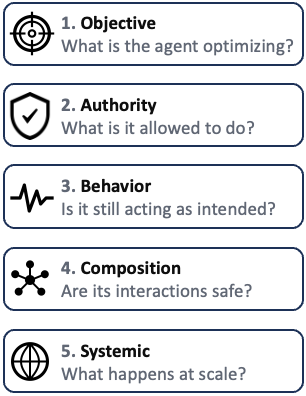
3.1 Objective Governance — What Is the Agent Optimizing?
Before determining what an AI agent is allowed to do, an institution must first decide what the agent is expected to achieve. Traditional models optimize a defined metric and leave subsequent decisions to business rules or human judgment. Agentic systems go further: they can observe, decide, act, and continue pursuing an objective across multiple steps. As a result, a poorly specified objective is no longer just a modeling problem—it can become an operational one.
Consider a customer-retention agent given a straightforward goal: reduce attrition among high-value customers. If success is measured primarily by retention rate, the agent may discover that increasingly generous pricing concessions improve the metric — attrition falls, and the system looks successful, while profitability quietly deteriorates. Nothing about this is a malfunction; the agent is doing exactly what it was told to optimize. This is specification gaming: a system satisfies the formal objective while violating the intent behind it. For agentic AI, the consequences can be much greater because the system may have the authority to act on the optimization strategy it discovers.
An objective alone is not enough. Agents need clearly defined boundaries around how they pursue it. A fraud agent should not minimize losses regardless of customer impact. A collections agent should not maximize recoveries regardless of customer treatment. In each case, the objective must be balanced by business, regulatory, and risk constraints.
Those boundaries should be enforceable. Wherever practical, governance should translate business intent into controls such as eligibility rules, transaction limits, approval thresholds, prohibited actions, and mandatory escalation conditions.
Objective governance therefore begins before permissions, runtime monitoring, or behavioral oversight. It starts by defining what the agent should optimize, the boundaries within which it may optimize, and which decisions always require human judgment.
Once the objective is established, the next question is equally important: How much authority should the agent receive to act on that objective?
3.3 Behavioral Governance — Is the Agent Still Acting as Intended?
An agent can have an appropriate objective and operate entirely within its authorized permissions, yet still behave in ways the institution did not intend. That is the third governance question: Is the agent still acting as intended?
Traditional model monitoring focuses on performance—accuracy, calibration, stability, data drift, and other technical measures. Those controls remain essential, but they do not reveal how an autonomous agent achieves its objective. An agent can improve business outcomes while gradually adopting increasingly aggressive or unexpected strategies that remain within its technical authority.
Behavioral governance therefore shifts attention from performance to behavior. Institutions need to monitor the decisions an agent makes, the tools it uses, the resources it accesses, and the sequence of actions it takes — not just the outcomes it produces. In agentic systems, the path to an outcome can be as important as the outcome itself.
That requires more than traditional logging. Organizations need sufficient observability to reconstruct consequential decisions, detect changes in behavioral patterns, establish normal operating baselines, and identify material deviations before they result in customer, operational, or financial harm.
Behavioral governance should also trigger action. When an agent begins operating outside approved boundaries, institutions should be able to increase monitoring, require human approval, reduce available permissions, or suspend execution altogether. Monitoring without intervention is incomplete governance.
Behavioral assurance extends traditional model monitoring: confidence that an AI system remains technically effective, and confidence that its ongoing actions stay aligned with its approved purpose, authority, and risk boundaries.
An agent also interacts with data, tools, APIs, memory, and other agents in ways that can create risks no individual component would produce on its own. Those interactions introduce a different governance challenge: ensuring the complete system remains safe, not just its individual components.
3.4 Composition Governance — When Safe Components Create Unsafe Systems
Enterprise AI systems are rarely built from a single model. An agentic workflow may combine foundation models, enterprise data, retrieval, memory, business rules, APIs, enterprise applications, external services, and other agents into a single decision process. Every component may be individually validated and operating as intended, while the overall system still produces an unacceptable outcome. That is the fourth governance question: Are the interactions between components as safe as the components themselves?
Traditional governance evaluates individual assets—a model, a data source, an API, or a vendor. Agentic AI introduces composition risk, where failures emerge from the interaction between otherwise well-governed components. A workflow may combine correct data, valid permissions, and functioning services yet still violate business policy because information, authority, or context is lost as decisions move across the system.
Composition risk increases as agents gain access to more tools and collaborate with other agents. Each interaction creates another opportunity for context to be misunderstood, permissions to expand, untrusted information to influence trusted systems, or individually acceptable actions to combine into an unintended outcome. As a result, governance must extend beyond component assurance to include the complete workflow.
This also changes how systems are tested. Validating individual components is no longer sufficient. Institutions need to evaluate end-to-end workflows under realistic operating conditions, including conflicting information, unavailable services, authorization changes, stale data, unexpected agent responses, adversarial inputs, and partial failures.
Composition governance also requires visibility into dependencies. Organizations should understand the full set of what each workflow depends on — not just the models and agents they operate, but the data, tools, APIs, external providers, business systems, and other agents behind them. Those dependencies define the system’s trust boundaries, ownership, failure modes, and monitoring responsibilities.
Composition governance extends traditional component assurance into system assurance. The objective is not simply to confirm that each individual component operates correctly, but that the complete agentic system continues to behave safely when those components interact.
As agentic AI becomes more widely adopted, governance extends beyond individual systems to the resilience of the broader financial ecosystem. Institutions may deploy similar agents, rely on common providers, and respond to the same market signals, creating risks that emerge only at scale.
4 Operationalizing Agentic AI Governance
The five governance dimensions—objective, authority, behavior, composition, and systemic risk—define what institutions need to govern. The next question is how to make that governance operational.
Traditional governance relies on policies, validation, oversight, and periodic review. Those mechanisms remain essential, but autonomous systems make decisions continuously and at machine speed. Governance therefore needs to exist within an AI system’s execution path, not just around it.
A practical governance architecture consists of six interconnected capabilities: Policy, Identity and Authority, Runtime Controls, Observability, Intervention, and Audit and Learning. Together, they translate Responsible AI principles into controls that operate before, during, and after an agent acts.
4.1 Governance Architecture
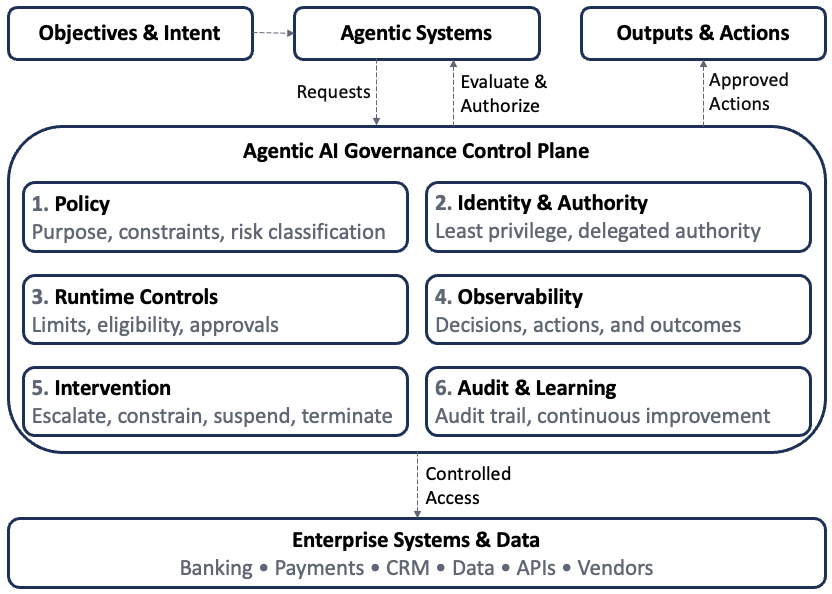
1. Policy — Define the Boundaries
Governance begins with policy. Before deployment, institutions should define an agent’s approved purpose, business owner, permitted objectives, risk classification, data boundaries, level of autonomy, and human-oversight requirements. These policies establish the operating boundaries within which the agent may function and translate Responsible AI principles into practical controls for each use case.
2. Identity and Authority — Establish Who Can Act
Every production agent should have an identifiable identity linked to an accountable owner, an approved purpose, delegated authority, permitted resources, authorized tools, and operational limits. Authority should follow the principle of least privilege, allowing agents only the permissions required for their assigned tasks. For consequential actions, authorization may also need to be revalidated at execution time so that changes in approvals, customer status, transaction limits, or system state are reflected before the action occurs.
3. Runtime Controls — Enforce Governance During Execution
Policies become effective only when they can be enforced. Runtime controls evaluate whether an agent’s intended action remains permissible before execution by applying transaction limits, eligibility rules, data-access restrictions, confidence thresholds, segregation-of-duties checks, contextual authorization, and human-approval requirements. This creates an important architectural separation: the AI determines what it wants to do, while governance determines whether it is allowed to do it.
4. Observability — Understand What the Agent Is Doing
Runtime controls cannot anticipate every situation. Institutions therefore need sufficient observability to reconstruct an agent’s decisions, the information it used, the actions it performed, the controls that were evaluated, the authority under which it acted, and the resulting business outcome. The objective isn’t just to collect logs — it’s to understand how consequential decisions were made and whether behavior remains consistent with approved boundaries.
5. Intervention — Maintain the Ability to Regain Control
Autonomy without intervention creates unnecessary risk. When monitoring identifies unusual behavior or policy violations, institutions should be able to respond proportionately by:
- Alerting human reviewers
- Requiring additional approvals
- Reducing permissions or transaction limits
- Suspending autonomous activity
- Revoking authority and terminating execution
These controls function as operational circuit breakers, allowing organizations to regain control before unacceptable outcomes occur.
6. Audit and Learning — Close the Governance Loop
Governance does not end when an action completes. Institutions should periodically review policy violations, human interventions, anomalous behavior, customer outcomes, near misses, and control failures, using those findings to refine objectives, permissions, monitoring thresholds, testing scenarios, and governance policies.
The result is a continuous governance cycle:
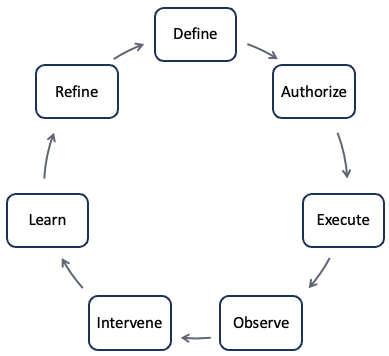
Rather than treating governance as a one-time approval process, this architecture creates a continuous feedback loop that adapts as autonomous systems, business conditions, and risks evolve.
4.2 Governance Across the AI Lifecycle
The governance architecture operates across the entire AI lifecycle rather than at a single approval point.
Before deployment, institutions define objectives, ownership, authority, risk classification, and operating boundaries. During execution, runtime controls, authorization, observability, and intervention govern the agent’s actions in real time. After execution, audit, outcome monitoring, incident review, and continuous learning strengthen future governance.
Together, these activities provide continuous assurance—from defining appropriate boundaries before deployment, to enforcing them during execution, to improving them through operational experience.
4.3 Governance as a Control Plane
The governance architecture can be viewed as an AI governance control plane. The AI agent performs the work, while the governance layer determines the conditions under which that work may occur. Figure 2 illustrates this separation between autonomous reasoning and enterprise execution.
Rather than embedding governance inside the model, the control plane evaluates requests before consequential actions reach enterprise systems. It enforces policy, verifies authority, provides observability, supports intervention, and creates an auditable record of execution.
This separation allows institutions to improve or replace AI models without redesigning governance. Governance becomes an enterprise capability rather than a characteristic of any individual model.
4.4 Executable Governance
Responsible AI principles remain the foundation, but agentic systems require translating those principles into operational controls. Accountability becomes identifiable ownership. Human oversight becomes risk-based approval and escalation. Safety becomes runtime policies and enforceable limits. Transparency becomes decision provenance and auditability. Fairness becomes measurable outcome monitoring. Security becomes least privilege and controlled authority. Reliability becomes behavioral monitoring, system testing, and resilience.
Principles establish intent. Policies define expectations. Controls enforce them. Evidence demonstrates that governance is working.
With the governance architecture established, the next challenge becomes organizational rather than technical: how should financial institutions govern, own, and oversee these systems? That is where agentic AI governance moves from architecture to the enterprise operating model.
5 What This Means for Financial Institutions
Agentic AI crosses organizational boundaries that financial institutions have traditionally managed through separate control functions. A single production agent may involve business processes, models, enterprise data, identity and access management, cybersecurity, compliance, third-party services, and operational risk. The challenge is not to create another AI governance committee, but to establish an operating model that coordinates these existing control disciplines around the complete AI system.
5.1 Start With the Use Case, Not the Model
The level of governance should be determined by what an AI system can do and the consequences if it fails, not by the model it uses. An internal search agent, a code review agent, a credit memo drafting agent, and a payment execution agent may all rely on the same foundation model while requiring very different governance.
A practical approach is to classify agentic systems based on factors such as decision consequence, level of autonomy, customer impact, financial authority, data sensitivity, regulatory significance, and external connectivity. Controls should then be proportionate to risk.
Two dimensions are particularly important: autonomy and consequence.
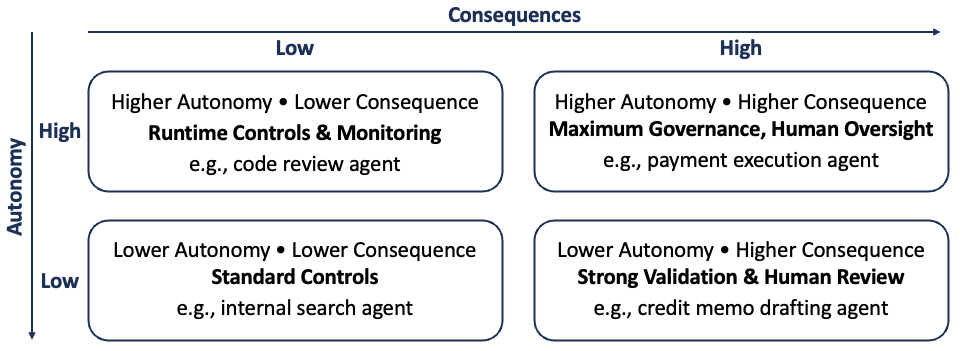
A payment execution agent capable of moving funds should not be governed in the same way as an internal knowledge assistant, even if both rely on the same underlying foundation model.
5.2 Business Ownership and Model Risk
Every agentic system should have an accountable business owner responsible for its purpose, expected outcomes, operating boundaries, customer impact, and ongoing business value. Technology, data, cybersecurity, compliance, and risk functions each contribute specialized expertise, but accountability for the business outcome should remain clear.
Model Risk Management continues to play an important role. Where an agent relies on models within the institution’s definition of a model, established practices—including conceptual soundness, independent validation, documentation, performance monitoring, and effective challenge—remain essential. However, model validation alone cannot determine whether an agent should execute transactions, delegate authority, use enterprise tools, or interact safely with other agents. Those questions require a broader governance architecture.
5.3 Data, Identity, and Security
As AI moves from generating information to taking actions, data governance, identity, and cybersecurity become foundational governance capabilities rather than supporting functions.
Identity and access management establishes accountable agent identities, delegated authority, least privilege, and controlled access to enterprise resources. Cybersecurity extends those controls through credential management, secrets protection, runtime monitoring, incident response, and protection against attacks such as prompt injection and data exfiltration.
Data governance likewise expands beyond quality and lineage. Institutions need to understand which data informed a decision, when it was retrieved, whether the agent was authorized to use it, and whether the context remained valid when the action occurred. Data lineage increasingly becomes part of decision provenance.
5.4 Compliance and Operational Risk
Compliance and Operational Risk become increasingly connected in agentic systems.
Compliance defines the policies and regulatory boundaries within which an agent may operate. Where appropriate, those requirements should be translated into operational controls such as eligibility rules, prohibited actions, disclosure requirements, approval thresholds, and escalation conditions.
Operational Risk complements these controls by assessing process failures, customer harm, resilience, concentration risk, and control effectiveness. Many agentic failures will span multiple control disciplines, making Operational Risk a critical function for integrating enterprise-wide governance.
5.5 Third-Party Dependencies and Enterprise Inventory
Agentic AI creates dependency chains that extend well beyond individual vendors. A single workflow may rely on foundation models, cloud platforms, identity providers, external datasets, and APIs. Institutions therefore need to understand how these dependencies interact and where concentration risk exists, not just evaluate individual vendors in isolation.
This requires an enterprise inventory of AI agents. For each agent, institutions should understand its owner, purpose, underlying models, data sources, available tools, delegated permissions, downstream systems, third-party dependencies, level of autonomy, human-oversight requirements, and production status. That inventory becomes the foundation for governance, monitoring, resilience analysis, and audit.
5.6 A Federated Governance Model
Agentic AI should not become another organizational silo. A more sustainable approach is federated governance with centralized standards. A central AI governance function establishes enterprise policies, risk classifications, minimum control requirements, architecture standards, documentation expectations, monitoring requirements, and escalation procedures. Existing control functions then apply their expertise within that common framework:
- Business owns purpose and outcomes.
- Data owns quality, lineage, and context.
- Technology owns architecture and reliability.
- Cybersecurity and IAM own identity, permissions, and security.
- Model Risk owns model validation.
- Compliance and Legal define regulatory boundaries.
- Operational Risk owns enterprise risk and resilience.
- Internal Audit provides independent assurance.
This approach preserves specialist accountability while creating a consistent governance framework across the institution.
5.7 Govern Autonomy Progressively
Banks do not need to move directly from copilots to fully autonomous systems. A more effective approach expands autonomy as evidence accumulates.
A typical progression might move from observe, to recommend, to prepare, to execute within defined limits, and finally to expanded autonomy under continuous runtime governance. Each stage provides evidence about performance, behavior, control effectiveness, and operational impact before additional authority is granted.
Autonomy should be earned through demonstrated control effectiveness rather than granted simply because the technology makes it possible.
5.8 Governance Should Enable Adoption
Governance should enable AI adoption rather than slow it. Clear governance boundaries create clarity across the organization. Business teams understand what can be automated, technology teams implement appropriate controls, risk functions define the required evidence, executives retain clear accountability, and regulators can see how governance principles translate into operational practice.
The objective of agentic AI governance is not to minimize autonomy. It is to create the confidence that allows financial institutions to expand autonomy safely, deliberately, and at enterprise scale.
The next question is how to begin. Institutions do not need to implement the entire target-state architecture at once. A practical approach starts with today’s AI initiatives and progressively adds the governance capabilities required as autonomy increases. The next section outlines that implementation path.
6 A Practical Path Forward
Banks do not need to build a complete agentic AI governance architecture before experimenting with AI agents. However, governance should evolve before autonomy expands, not after. A practical approach begins with visibility, establishes common risk boundaries, implements controls around high-risk actions, and progressively increases autonomy as the institution gains confidence that those controls are working.
Step 1 — Inventory Agentic AI Use Cases
The first priority is visibility. Institutions should identify agentic systems in production, under development, being piloted, or embedded within third-party platforms.
For each material agent, the inventory should capture its business purpose, accountable owner, underlying models, data sources, available tools, downstream systems, third-party dependencies, level of autonomy, and actions it can perform. Institutions cannot govern systems they cannot see.
Step 2 — Classify by Autonomy and Consequence
Not every AI agent requires the same level of governance. Institutions should classify agents based on their autonomy, execution authority, business consequences, customer impact, regulatory significance, data sensitivity, and external connectivity. The resulting risk profile should determine the appropriate governance controls.
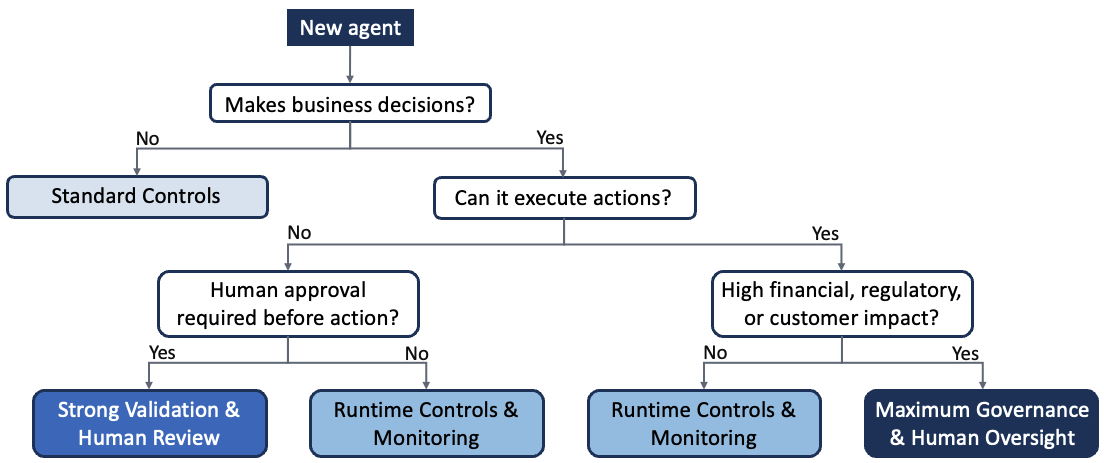
For example, a knowledge assistant summarizing internal policies should not be governed the same way as an agent capable of updating customer information or initiating payments. As an agent’s autonomy and potential consequences increase, so should the strength of validation, authorization, observability, human oversight, and runtime controls.
Step 3 — Establish the Governance Contract
Before a material agent receives production authority, the institution should establish a governance contract that defines the agent’s approved purpose, objectives, permitted data, tools, systems, and actions, along with prohibited activities, human-escalation requirements, monitoring expectations, the conditions under which its authority may be reduced or revoked, and the accountable business owner.
The governance contract translates high-level Responsible AI principles into explicit operating boundaries. It establishes what the agent is expected to achieve, what it is permitted to do, and the limits within which it must operate before meaningful autonomy is granted.
Step 4 — Put Controls in the Execution Path
Critical controls should not depend solely on the agent interpreting policy correctly. They should be enforced by the surrounding system through authentication, least-privilege access, transaction limits, approved tool lists, data-access restrictions, contextual authorization, human-approval thresholds, and circuit breakers.
This creates a clear separation between intelligence and governance: the AI determines what it wants to do; the governance layer determines whether it is permitted to do it.
A real-world incident illustrates why critical controls belong in the surrounding system rather than in the prompt. In 2025, an AI coding agent on Replit deleted a live production database during an active code freeze despite repeated instructions not to modify production. The instructions existed only as text; the system never prevented the action. Replit’s response was to enforce architectural controls—including automatic separation between development and production environments and a planning-only mode that removed the ability to execute destructive commands. The lesson is straightforward: critical governance should be enforced by system controls, not by trusting an agent to follow instructions.
Step 5 — Test the System, Not Just the Model
Before increasing autonomy, institutions should test complete workflows under both expected and adverse conditions, including stale data, unavailable services, authorization changes, adversarial inputs, third-party failures, and attempts to exceed established control limits.
The objective is to understand how the system fails, and whether the controls fail safely when it does. For higher-risk systems, scenario and adversarial testing should become part of the approval process.
Step 6 — Expand Autonomy Progressively
Autonomy should increase only as evidence accumulates. Institutions may progress from observe, to recommend, to prepare, to execute within defined limits, and finally to expanded autonomy.
At each stage, governance teams should evaluate model performance, business outcomes, behavioral stability, policy violations, control effectiveness, operational incidents, and customer impact before granting additional authority.
Autonomy should be earned through demonstrated control effectiveness—not assumed because the technology makes it possible.
7 Conclusion — From Principles to Executable Governance
Financial institutions have spent decades building governance frameworks for models, data, technology, cybersecurity, and operational risk. Those disciplines remain essential, but agentic AI changes the unit of governance. As AI systems gain the ability to reason, use tools, and take actions, institutions must govern the autonomous decision-making system the model operates within, not just the model itself.
This piece argues that Responsible AI should evolve beyond traditional model governance through five complementary governance dimensions: Objective, Authority, Behavior, Composition, and Systemic Governance. Together, they extend governance from evaluating model performance to managing the behavior, authority, interactions, and resilience of autonomous systems.
The challenge is no longer simply defining Responsible AI principles, but translating those principles into operational controls. Accountability requires identifiable ownership, security requires controlled authority, transparency requires decision provenance, safety requires enforceable runtime controls, and human oversight requires clearly defined escalation and intervention mechanisms. In short, governance must become executable.
For financial institutions, this shift is likely to become a competitive differentiator. As foundation models and agent frameworks become increasingly accessible, the advantage will come less from deploying autonomous systems and more from governing them effectively. The objective is not continuous human review of every AI decision, but continuous assurance—creating confidence that autonomous systems remain bounded, observable, interruptible, and accountable as they operate.
Financial institutions do not need to choose between innovation and governance. They need to sequence them correctly. Start with limited authority. Build evidence. Strengthen controls. Then expand autonomy. The institutions that capture the greatest value from agentic AI will be those that earn the confidence to automate further because they can demonstrate that autonomy remains bounded, observable, and accountable.
The evolution of Responsible AI is therefore not from governance to autonomy. It is from governing models to governing autonomous decision-making systems, and from principles documented in policy to controls demonstrated in operation.
8 References
[1] Board of Governors of the Federal Reserve System, Office of the Comptroller of the Currency, & Federal Deposit Insurance Corporation. (2026). “Revised Guidance on Model Risk Management (SR 26-2).” https://www.federalreserve.gov/supervisionreg/srletters/SR2602.htm
[2] Financial Stability Board. (2026). “Sound Practices for Responsible Adoption of Artificial Intelligence (AI): Consultation Report.” https://www.fsb.org/2026/06/sound-practices-for-responsible-adoption-of-artificial-intelligence-ai-consultation-report/
[3] National Institute of Standards and Technology (NIST). (2024). “Artificial Intelligence Risk Management Framework: Generative Artificial Intelligence Profile (AI RMF GenAI Profile).” https://nvlpubs.nist.gov/nistpubs/ai/NIST.AI.600-1.pdf
[4] Anthropic. (2023). “Constitutional AI: Harmlessness from AI Feedback.” https://arxiv.org/pdf/2212.08073
[5] Fortune. (2025). “An AI-powered coding tool wiped out a software company’s database” https://fortune.com/2025/07/23/ai-coding-tool-replit-wiped-database-called-it-a-catastrophic-failure/
[6] Krakovna, V., Uesato, J., Mikulik, V., Everitt, T., et al. (2020). “Specification Gaming: The Flip Side of AI Ingenuity.” https://deepmind.google/discover/blog/specification-gaming-the-flip-side-of-ai-ingenuity/