Beyond Dashboards: The Rise of Agentic Analytics
1 Why Analytics Teams Are Falling Behind
Ten years ago, most companies worked with a few thousand rows of structured data per day — mainly clean records from CRMs, ERPs, and transactional systems. Today, mobile logs, app activity, and real-time streams push that number into the millions. The scale has changed entirely, yet teams are still trying to manage it with tools built for a slower world.
Instead of helping shape strategy, many analytics teams are stuck doing manual work — pulling data, formatting reports, chasing down numbers. By the time insights are generated, the moment to act has passed. In fast-moving industries like retail, healthcare, and finance, that delay can mean lost customers, missed revenue, and falling behind the competition.
According to McKinsey, up to 80% of time in advanced analytics projects is spent just preparing data — not analyzing it. Even after insights are found, teams often struggle to act on them fast enough. In a real-time world, this delay is a problem. What’s needed now is a shift — from data presentation to decision augmentation.
2 The Evolution of Business Analytics
To understand where we are going, we need to look at how the “distance to data” has shrunk over the last forty years.
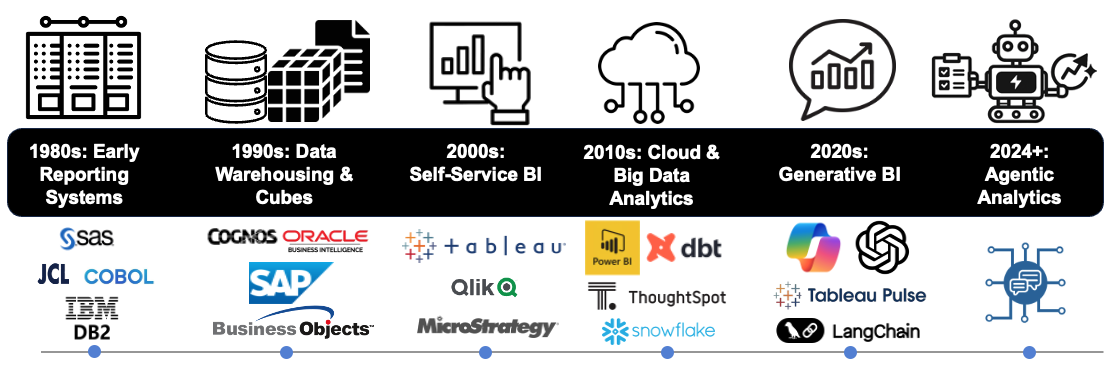
1980s: Early Reporting Systems
Business Intelligence started in the 1980s with IT-led reporting systems. Reports were static, manually coded (often in COBOL or SAS), and generated on mainframes. Business users had no direct access—they received scheduled, printed reports. Everything was batch-processed, and changes required developer intervention.
1990s: Traditional BI and Data Warehousing
In the 1990s, organizations centralized their data. They built ETL pipelines to pull data from operational systems into warehouses. OLAP tools became popular, allowing users to slice and dice data through pre-defined cubes. BI platforms like Oracle BI, IBM Cognos, SAP BW, and BusinessObjects dominated this era. Reports became more dynamic, but business users still relied heavily on IT to build queries and dashboards.
2000s: Self-Service BI
In the 2000s, self-service BI made data accessible to everyone. Tools like Tableau and QlikView allowed business users to explore data on their own, without writing SQL or relying on IT. This era emphasized drag-and-drop visualizations, data discovery, and faster decision-making. Analysts could now manually pull in data, create dashboards, and make faster decisions—without depending on IT.
2010s: Cloud and Big Data Analytics
The 2010s introduced cloud-native analytics. Data moved from on-premise warehouses to scalable platforms like Snowflake, BigQuery, and Redshift. Tools like Looker, Power BI, and MicroStrategy enabled centralized semantic layers, allowing consistent metric definitions across teams. dbt made data transformation accessible to analysts using SQL. The BI stack became modular and scalable.
Late 2010s: Augmented Analytics
Starting around 2017, BI platforms began adding AI capabilities — including anomaly detection, automated insights, and natural language summaries. ThoughtSpot and Tableau’s Ask Data allowed users ask questions in plain English. Power BI introduced automated insights. Machine learning moved from data science teams into everyday analytics tools.
Early 2020s: Generative BI
With the rise of Large Language Models, BI became conversational. Tools like Power BI Copilot and LangChain-based agents let users explore data through natural dialogue. Instead of clicking through dashboards, users could ask “Why did sales drop last month?” and receive visual summaries and text explanations in real time. BI became more interactive and intuitive, but users still needed to interpret results and act.
2024 Onward: Agentic Analytics
We are now entering the agentic era. These systems don’t just answer questions—they can proactively explain them, suggest next steps, and take actions. Unlike traditional BI, agentic tools can monitor live data, analyze risks, and make context-aware decisions. They can identify patterns, propose solutions, and initiate workflows across systems. Agentic Analytics bridges the last mile from insight to impact — closing the loop between data, decision, and execution.
3 What Makes Analytics Agentic?
Most analytics tools today are still passive. They wait for users to ask questions, click filters, or export data. Even with Gen AI, the user still has to take action. Agentic Analytics changes that. These systems don’t just respond — they act. They monitor conditions, interpret intent, propose actions, and, in many cases, carry out tasks automatically. In short, Agentic Analytics closes the loop between insight and action.
Here’s what makes it different:
It Monitors What Matters — Agentic systems continuously scan key data sources including business systems, documents, emails, and sensors. They surface relevant signals without needing a human to pull the data.
It Understands Context — When patterns change, the agent knows why. Seasonal fluctuation? Supply chain issue? Competitor move? It connects dots across systems to see the full picture.
It Takes Action — Agents don’t just flag issues—they fix them. Adjust pricing. Reroute shipments. Schedule staff. Update inventory. No waiting for approval on routine decisions.
Agentic systems don’t just shorten time-to-insight — they reduce time-to-action.
4 Traditional vs. Generative vs. Agentic BI
Here’s how analytics has evolved across three generations — from dashboards, to dialogue, to delegation.
| Aspect | Traditional BI | Generative BI | Agentic Analytics |
|---|---|---|---|
| User Interaction | Click through dashboards | Ask questions in plain English | Set goals and let agents work |
| Insight Generation | Manual, user driven | Prompted, conversational. | Proactive, autonomous |
| Speed to Insight | Minutes to hours | Seconds to minutes | Already done before you ask |
| Output | Predefined dashboards | Dynamic answers | Completed actions |
| Decision Making | Fully manual, requires human follow up | AI-assisted, requires human follow up | AI-executed with oversight |
Most users of tools like Power BI rely on prebuilt dashboards and don’t write queries — but they still need to interpret visuals, apply filters, and manually extract insights.
Generative BI reduces that burden by allowing users to ask questions in plain English. However, speed and accuracy still depend on how complete and well-structured the data model is. If key fields are missing, answers may be delayed or misleading.
Agentic systems go further — they monitor live data, generate insights, and sometimes take action. The goal isn’t just automation, but intelligent delegation — with users staying in control.
5 Real-World Examples Across Industries
Banking: An agent monitors transaction patterns and detects signs of account attrition. It automatically generates a personalized retention offer, alerts the relationship manager, and triggers an outbound message — reducing churn without manual review.
Retail: An agent detects that a competitor has dropped prices on winter coats. It adjusts regional pricing, reorders popular sizes, and alerts the marketing team — all before anyone notices a dip in sales.
Healthcare: An agent monitoring patient vitals spots early signs of sepsis. It alerts the care team, orders labs, and preps equipment, helping doctors respond quickly and consistently.
Manufacturing: A factory agent picks up abnormal vibration in a machine. It schedules maintenance, orders parts in advance, and adjusts the production schedule to avoid downtime.
E-commerce: An agent sees a customer abandon their cart at checkout. It offers alternate payment methods, applies a discount, and emails the saved cart link — recovering the sale without human intervention.
While agentic systems can act autonomously, the level of human oversight depends on the context. For high-risk or high-impact decisions — such as patient care, pricing changes, or customer interactions — humans remain in the loop. For routine tasks with clear rules, agents can execute independently within set boundaries.
6 Building Your Agentic System
To build a system that’s truly agentic—not just automated—you need a strong foundation. Following components ensure agents can act intelligently, safely, and at scale.
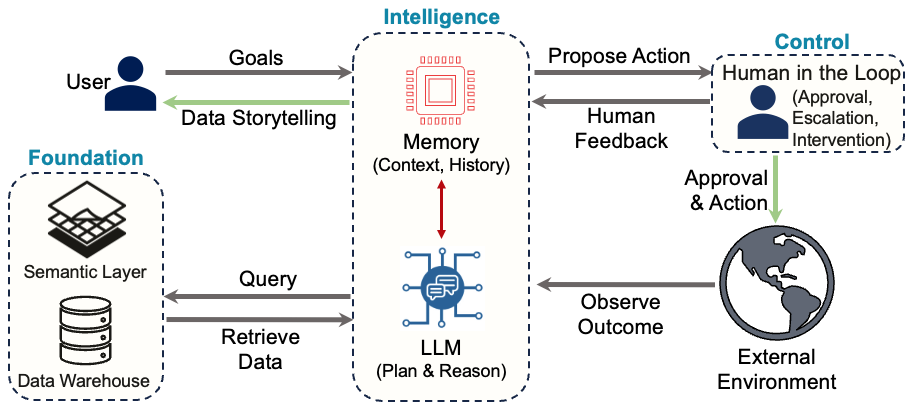
6.1 Foundation Components (Must-Have)
Clean Data Foundation: Agents need accurate, connected data to make good decisions. If your data is messy or incomplete, they’ll make confident—but wrong—choices. Fix data quality first.
The Semantic Layer: Think of this as a shared dictionary. It ensures both humans and machines speak the same language. When an agent tags a “high-priority customer,” everyone—from sales to service—knows exactly what that means.
Integration Points: Agents need to connect to everything: ERP, CRM, supply chain systems, external data feeds. They need function calling capabilities to invoke specific functions through APIs.
6.2 Intelligence Components (Make Agents Smart)
Agent Memory: Your agents need to remember patterns over time. Agent memory stores past queries, user preferences, and analytical outcomes. An agent that remembers your seasonal patterns doesn’t need to rediscover them every quarter.
Data Storytelling: Numbers without narrative are just noise. Agents should explain insights in ways different audiences understand—executive summaries for CEOs, technical analysis for data teams, action items for managers.
Embedded Analytics: Don’t make users hunt for insights. Embed agents where work happens—in your CRM, ERP, or communication tools. Analytics becomes invisible but everywhere.
6.3 Control Components (Keep Things Safe)
Governance Framework: Set clear rules about what agents can do alone versus what needs approval. When the agent is 95% confident, let it act. When it’s 60% confident, require human review.
Audit and Explainability: Every decision must be traceable. You need bias detection, natural language explanations, data lineage tracing, and uncertainty quantification.
Platform Administration: Track usage, manage costs, optimize performance. Without proper administration, costs spiral and performance degrades. Think of it as agents that tune themselves.
Most agentic systems follow a simple loop:
1. Set a goal
2. Monitor for signals
3. Simulate or suggest actions
4. Act — with or without approval
7 Risks to Watch in Agentic Analytics
Agentic systems represent the next leap in analytics — moving beyond dashboards and insights to systems that reason, decide, and act. But with this autonomy comes a new class of risks. These are no longer just about data quality or model accuracy. They’re about decision quality, goal alignment, and control. Below are seven key risks that organizations must address, along with proven mitigation strategies.
1. Inaccuracy & Hallucination
Just like GenAI, agentic systems may act on flawed reasoning or hallucinated information — especially in open-ended or ambiguous situations. A conversational agent might confidently trigger an action based on a faulty interpretation. To mitigate this, it’s critical to start in low-risk domains, keep humans in the loop during early phases, and validate outputs before allowing agents to take autonomous actions.
2. Overtrust & Automation Bias
As agents begin to explain their actions in fluent natural language, users may over-rely on their recommendations — even when confidence is low. This “automation bias” can cause risky behavior if users stop double-checking. A good mitigation strategy is to display uncertainty scores, build in approval checkpoints, and log decisions for transparency and review.
3. Goal Misalignment
Agents act based on the goals we define. If those goals are vague or poorly aligned, agents can optimize the wrong outcomes. For example, a customer service agent might prioritize speed over quality. To prevent this, define clear, bounded goals and constraints. Simulate agent behavior in sandboxed environments before deployment to ensure alignment with real-world expectations.
4. Security & Tool Access Risks
The same autonomy that enables agents to trigger actions—like sending emails or invoking APIs—also creates surface area for misuse. If an agent has overly broad permissions, it can act in ways that compromise security. Limit tool access based on least-privilege principles, isolate critical actions behind human approval, and maintain audit logs of every tool invocation.
5. Data Privacy & Leakage
Agents that rely on third-party APIs or external LLMs may inadvertently share sensitive data outside the organization. This risk grows in domains like healthcare, finance, or legal workflows. To mitigate, redact personal or confidential data before processing, and use self-hosted LLMs or secure APIs where data privacy is essential.
6. Regulatory Exposure
Regulators are increasingly focused on explainability, accountability, and auditability. If an agent makes a high-impact decision—say, approving a loan or escalating a fraud alert—organizations must be able to show how and why the decision was made. Build explainability into every layer: log agent prompts, decisions, and tool usage. For regulated industries, treat agents as supervised systems with clear audit trails and human oversight.
7. Organizational Readiness Gaps
Agentic analytics blurs the lines between data teams, product teams, and operations. Without clear roles and ownership, organizations may struggle to monitor agent behavior, update rules, or respond to unexpected issues. Assign responsible owners for every agent system, build monitoring dashboards, and schedule periodic alignment reviews to ensure continued business fit.
7.1 Building a Governance Foundation for Agentic Analytics
To manage these risks, organizations need more than technical solutions — they need governance frameworks that are proactive and context-aware. Begin by enforcing human-in-the-loop (HITL) checkpoints in all high-stakes domains. Establish explainability and traceability standards: whether through interpretable model frameworks, decision metadata, or visual logs of reasoning chains. Maintain detailed prompt and output logging so agent decisions can be reconstructed, reviewed, and improved over time.
Access controls and guardrails are especially critical. They define what agents are allowed to access or trigger — and set clear boundaries to prevent unintended actions or overreach. Periodic reviews are crucial to ensure that agents remain aligned with evolving business goals, policies, and risk thresholds. Practices like red teaming (simulating failure modes) can uncover vulnerabilities before they emerge in production.
Not every agent needs full autonomy. Many organizations start with “copilot” modes where agents assist humans with recommendations, but defer final decisions. Over time, as trust and guardrails mature, selective automation can be introduced in well-scoped areas.
8 Embracing the Next Frontier — Responsibly
Agentic Analytics marks a turning point — where insights aren’t just delivered but acted on. It promises faster decisions, leaner operations, and more adaptive teams. But like any other technology, its value depends on how thoughtfully it’s deployed.
Organizations that move first — and move responsibly — will gain the most. That means combining innovation with oversight, automation with accountability. Start small. Build trust. Put guardrails in place. Then let your agents help you scale what humans do best: reason, decide, and lead.